
Anup Saha, currently a Wholetime Director at Kotak Mahindra Bank, has been appointed as the new Managing Director and Chief Executive Officer for a three-year term, effective January 1, 2027, with the Reserve Bank of India's approval.
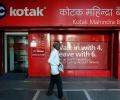
Kotak Mahindra Bank's net interest margin is likely to swell after the Reserve Bank of India (RBI) lifted its restrictions on the private lender that barred it from issuing fresh credit cards and onboarding new customers through digital mode, brokerages said on Thursday. The bank's net interest margin (NIM) has seen a decline of over 35 basis points (bps) since the restrictions were imposed by the regulator in April 2024.

ITC, State Bank of India, HCL Technologies and IndusInd Bank were the other big laggards. NTPC, UltraTech Cement, HDFC Bank and Mahindra & Mahindra were among the gainers.

Over a dozen mutual fund houses in India have temporarily suspended fresh subscriptions in their gold fund of funds (FoFs) and gold-silver FoFs, a move believed to be influenced by directions from the Securities and Exchange Board of India (Sebi) ahead of the festive season.

Global payments solution major Mastercard has fully exited Indian fintech firm Pine Labs, selling its entire 4.31 per cent stake for Rs 933 crore through block deals on the BSE.

Jio Platforms Ltd's initial public offering (IPO), anticipated to be India's largest, is scheduled to open for subscription on October 21 and close on October 23, with reservations for employees and Reliance Industries Ltd shareholders.

Indian banks are projected to achieve healthy profit growth in the second quarter of financial year 2027 (Q2FY27), driven by lower credit costs, robust advance growth, and fee income. However, net interest margins (NIMs) are expected to face pressure due to significant mobilisation of foreign currency non-resident (bank) FCNR(B) deposits.

Indian stock markets witnessed a significant rebound, with the Sensex rallying 1,109 points and the Nifty closing above 22,720, driven by strong performances in IT and financial sectors, a recovering rupee, and Finance Minister Nirmala Sitharaman's comments on long-term capital gains (LTCG) tax.

Shares of major private lenders, including HDFC Bank, Axis Bank, and Kotak Mahindra Bank, experienced a sharp selloff after their June-quarter results indicated persistent pressure on net interest margins (NIMs), despite healthy credit growth. This decline overshadowed gains in ICICI Bank and Punjab National Bank (PNB), which reported resilient or stronger-than-expected earnings.

The 200-DMA is a closely watched indicator of a stock's long-term trend and can serve as an early warning of trouble.
Kotak Mahindra Bank on Saturday reported a 25 per cent growth in its March quarter net profit at Rs 5,302 crore, limited by a drop in the core income due to narrow interest margins. On a standalone basis, the city-headquartered lender's Q4 net profit grew 18 per cent to Rs 4,133 crore. The FY24 consolidated net profit grew 22 per cent to Rs 18,213 crore.

Jio Platforms' initial public offering has garnered an overwhelming institutional demand of approximately Rs 2.5 lakh crore, significantly exceeding its Rs 8,110-crore anchor book, with global and domestic investors vying for a stake in the Reliance Industries subsidiary.

With the RBI capping top managements' tenure at lenders, Kotak Mahindra Bank's head Uday Kotak on Monday said his current term as the managing director and chief executive is till December 2023 and the board will take a call on succession in due course. Kotak also stressed that the commitment to institution building has been a core value for the entity over the last 36 years of its existence. The RBI last week capped MD and CEOs' terms at private sector lenders at 15 years, from October 1 onwards, but has allowed the serving bank heads to complete their current appointments. Uday Kotak, who is also among the promoters of the lender, has been at the helm for over 17 years already.

Indian benchmark indices, Sensex and Nifty, closed lower on Wednesday, reversing early gains due to profit-taking and weakness in sectors like IT, FMCG, and consumer durables, despite support from lower crude oil prices.

The Reserve Bank of India's recent measures, including a dedicated dollar window for state-run oil marketing companies and tightened foreign exchange derivative rules, are expected to provide near-term relief to the rupee's depreciation, but market participants believe global factors and balance of payment dynamics will continue to exert pressure in the medium term.

The Reserve Bank of India (RBI) maintained its key policy rates for the fourth consecutive time, keeping the repo rate at 5.25 per cent, while the benchmark BSE Sensex closed 152 points higher in a volatile session, recovering from an intraday dip.

Benchmark equity indices Sensex and Nifty extended their gains for the second straight session on Monday, driven by optimism over the India-US trade deal and robust buying in public sector banks, consumer durables, and realty stocks.

The Reserve Bank of India (RBI) has maintained its benchmark policy rate at 5.25 per cent for the fourth consecutive meeting, prioritising clarity on inflation trends, particularly concerning energy costs and geopolitical developments.

The asymmetry in deposit and credit growth is the biggest challenge before the Indian banking industry. For every 100 deposit that a bank mobilises, it needs to keep 3 with the banking regulator in the form of cash reserve ratio on which it doesn't earn any interest. Another 18 is used for buying government bonds (statutory liquidity ratio). This means, a bank is left with 79 for giving credit. Add to this, its capital which can be used for giving loans. Most banks are facing a fund crunch. They need to find ways to attract deposits if they want to sustain credit growth, explains Tamal Bandyopadhyay.

The Indian corporate bond market witnessed a significant surge, with companies raising nearly Rs 16,000 crore in a single day, primarily led by state-owned financial institutions and NBFCs. This strong momentum, driven by improved borrowing conditions and investor confidence, is expected to persist.


Indian stock markets saw a significant rebound, with the Sensex jumping nearly 790 points, primarily fuelled by strong buying interest in telecom, pharma, and private banking shares, despite a volatile trading session and a weakening rupee.

The initial public offer of app-based beauty and home services platform Urban Company Ltd received overwhelming investor participation, with the issue getting a huge 103.63 times subscription on the last day of bidding on Friday. The Rs 1,900-crore IPO received bids for 11,06,46,08,960 shares against 10,67,73,244 shares on offer, according to NSE data.

From the 30-Sensex firms, NTPC, Trent, Bajaj Finance, Power Grid, Maruti, State Bank of India, ICICI Bank and Bharat Electronics were among the biggest gainers. In contrast, ITC, Kotak Mahindra Bank, Titan Company, Axis Bank and Bharti Airtel were the laggards.
The BSE Sensex plummeted 1,236 points, wiping out nearly Rs 7 lakh crore in investor wealth, driven by escalating tensions between the US and Iran and subsequent market selloff.
Stock markets closed higher for the second straight session on Tuesday, driven by gains in bank, IT and capital goods shares.

Digital payments provider PhonePe has filed draft papers with markets regulator Sebi for its upcoming initial public offering (IPO) using the confidential pre-filing route. On Wednesday, the company's spokesperson said, "PhonePe Ltd has filed the Pre-filed Draft Red Herring Prospectus with Sebi and the stock exchanges, under...the Sebi ICDR Regulations in relation to the proposed initial public offering of its equity shares on the main board of the stock exchanges".

With several $500 million-plus deals in the pipeline -- including ICICI Prudential AMC, Lenskart, PhonePe, Groww, PhysicsWallah, Meesho, Pine Labs, and Zepto -- investment bankers look poised for another year of hefty bonuses in 2025.

The domestic initial public offering (IPO) market is experiencing a significant surge, fuelled by the financialisation of savings, digital ease of investing, and expanding participation from both retail and institutional investors, investment bankers said on Wednesday.
Bajaj Finance, Bajaj Finserv, NTPC, State Bank of India, Power Grid, HDFC Bank, Tech Mahindra and Asian Paints were the other gainers. However, Zomato, Adani Ports, Tata Consultancy Services, Mahindra & Mahindra, Maruti and Tata Motors were among the laggards.
Foreign Institutional Investor Warburg Pincus International will pick up 2.75 per cent stake in Kotak Mahindra Bank for Rs 75.9 crore (Rs 759 million), subject to shareholders' approval.

These super-rich Indians intend to reside in their chosen host country permanently while retaining their Indian citizenship.

On the other hand, Bharat Electronics, Kotak Mahindra Bank and Axis Bank were the laggards. In Asian markets, South Korea's Kospi, Japan's Nikkei 225 index, Shanghai's SSE Composite index and Hong Kong's Hang Seng settled higher.

The Rs 6,145-crore initial public offer of electric two-wheeler company Ola Electric Mobility got fully subscribed on the second day of bidding on Monday, driven by demand from retail investors and non-institutional investors. The initial share sale received bids for 49,43,63,610 shares against 46,51,59,451 shares on offer, translating into 1.06 times subscription, according to the NSE data.

BharatPe co-founder and managing director Ashneer Grover, who was recently embroiled in a controversy over purportedly using abusive language against Kotak Mahindra Bank staff, has taken a voluntary leave till March-end. Grover informed the company's Board about his decision to proceed on leave earlier in the day, as per a statement issued by the fintech company on Wednesday. "For now, the Board has accepted Ashneer's decision which we agree is in the best interests of the company, our employees and investors, and the millions of merchants we support each day," it said. It added that the company will continue to be led by its CEO Suhail Sameer and its management team.

Among major Sensex gainers Bajaj Finserv rose the most by 1.42 per cent, Axis Bank gained 0.80 per cent, Infosys by 0.72 per cent, Mahindra & Mahindra by 0.60 per cent, Tata Motors by 0.55 per cent, Bajaj Finance by 0.53 per cent and Tata Steel by 0.52 per cent. Kotak Mahindra Bank, ICICI Bank, HCL Technologies, Bharti Airtel, Maruti Suzuki India, Trent Ltd and Tata Consultancy Services were the losers.

Capex, infrastructure development, and prudent fiscal management are the key focus areas in the Budget, says Nilesh Shah.
Titan, HCL Tech and State Bank of India were also among the laggards. However, Hindustan Unilever, Asian Paints, ICICI Bank, Power Grid, HDFC Bank and ITC were the gainers.

Other gainers included Nestle India, Asian Paints, Bajaj Finance, NTPC, L&T, Axis Bank and Bajaj Auto. On the other hand, TCS, ONGC, Infosys, HDFC and SBI were among the laggards. NSE Nifty surged 121.65 points or 1.03 per cent to 11,889.40.

Unlike any other business, banking is a turf where the captain's role is the most critical. Often a bank is defined by the personality of the CEO who runs it. Both HDFC Bank and Kotak Mahindra Bank are the creation of their CEOs, notes Tamal Bandyopadhyay.
